
TOKYO HIGH DENTAL CLINIC
Malocclusion
In brief
Malocclusion refers to anything that is not normal occlusion — an abnormal number or arrangement of teeth, or an abnormal relationship between the upper and lower jaws.
Orthodontic care at Tokyo High Dental is handled from the first consultation to the end of treatment by Dr. Ahn Jin-gyu, who completed formal orthodontic training and a doctoral course at Tokyo Medical and Dental University. Treatment is planned after reviewing skeletal, dental and facial balance on a 3D high-resolution CT (VATECH).
What is malocclusion?
Because anything that is not ‘normal occlusion’ is called ‘malocclusion’, if you know and understand what ‘normal occlusion’ is, it becomes easier to understand what ‘malocclusion’ is.
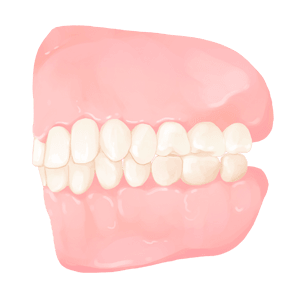
‘Normal occlusion (normal occlusion)’ means
- the number of upper and lower teeth is normal,
- the teeth are not spaced, rotated, or overlapped,
- the upper and lower teeth form a close occlusal relationship so that there is no functional problem in performing the chewing function,
- and, in addition, the position of the upper and lower jaws is also normal, giving an aesthetically natural facial appearance.
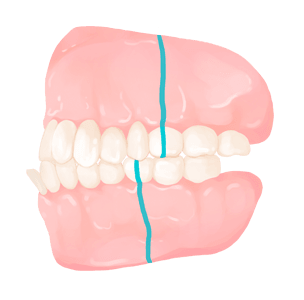
‘Malocclusion (malocclusion)’ can be understood as the opposite concept.
- the number of teeth is abnormal,
- the teeth are spaced, rotated, or overlapped,
- the upper and lower teeth do not fit together well, so there is a problem with the chewing function,
- and the position of the upper and lower jaws is abnormal (retrognathism, protruding jaw, or facial asymmetry, etc.), giving a facial appearance that is not aesthetic.
Malocclusion
Causes (Moyers)
Heredity
Developmental defects of unknown cause
Trauma: prenatal trauma and injury at birth, and postnatal trauma
Physical agents
Habits: finger sucking, tongue thrusting, lip biting, etc.
Disease: systemic/local disease, endocrine disorders
Malnutrition
Types of malocclusion
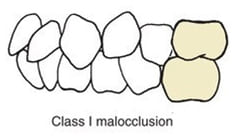
Class I malocclusion
In Class I malocclusion, the front-to-back relationship of the molars is normal.
Most malocclusions in this category are dental, with symptoms such as rotation, misalignment of individual teeth, missing teeth, and tooth-size discrepancy. Cases in which the molars occlude normally but the whole dentition protrudes forward (called bimaxillary alveolar protrusion) also belong to this category.
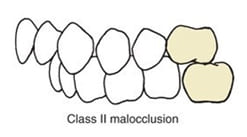
Class II malocclusion
In Class II malocclusion, the upper molars are positioned forward relative to the lower molars.
1. The upper jaw grows excessively while the lower jaw grows normally
2. The upper jaw grows normally while the lower jaw grows insufficiently
3. The upper jaw grows excessively while the lower jaw grows insufficiently. The upper teeth and lips often appear to protrude.
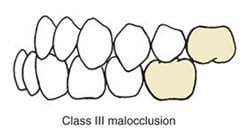
Class III malocclusion
In Class III malocclusion, the lower molars are positioned forward relative to the upper molars. The lower jaw appears to protrude, and the lower teeth often cover the upper teeth.
Frequently Asked Questions
How long does orthodontic treatment take?
Full orthodontic treatment usually takes about one and a half to two years, and partial orthodontics often finishes within six months to a year.
Is orthodontic treatment very painful?
There is soreness or discomfort for the first few days, but you gradually get used to it. Painkillers can be prescribed if needed.
Are there food restrictions during orthodontic treatment?
Hard or sticky food (taffy, caramel, etc.) can damage the appliance, so it is best to avoid them.
This treatment information was reviewed by our dental team on 2026-07-29.